Advanced scientific infrastructures require hermetic feedthroughs that work under extreme conditions. These electrical interfaces must combine vacuum integrity, radiation resistance, high-voltage insulation and long-term reliability.
From Proven Experience to New Scientific Challenges
Hermetic feedthroughs are among the smallest components in the systems they serve. They are also among the most critical. A superconducting magnet assembly represents years of engineering, months of assembly and a commissioning process that cannot easily be repeated. Once installed and cooled down, its electrical interfaces are no longer accessible.
Therefore, a single connector that loses its seal can force the entire assembly to be warmed up, disassembled and recommissioned. In other words, the intervention is measured not in components replaced, but in months of lost operation. The flange that carries those connectors is not an accessory. Above all, it is a component that is not allowed to fail.
In this context, technology created for one scientific programme often solves the same problem in another. For example, VAC-TRON worked with GSI Helmholtzzentrum für Schwerionenforschung and ASG Superconductors on the FAIR project (Facility for Antiproton and Ion Research). Engineering methods, manufacturing know-how and validation practices from the ITER ecosystem fed directly into a new family of custom hermetic feedthroughs for superconducting magnets.
As a result, expertise built for fusion research now supports cutting-edge particle physics.
FAIR and the Super-FRS Superconducting Multiplets
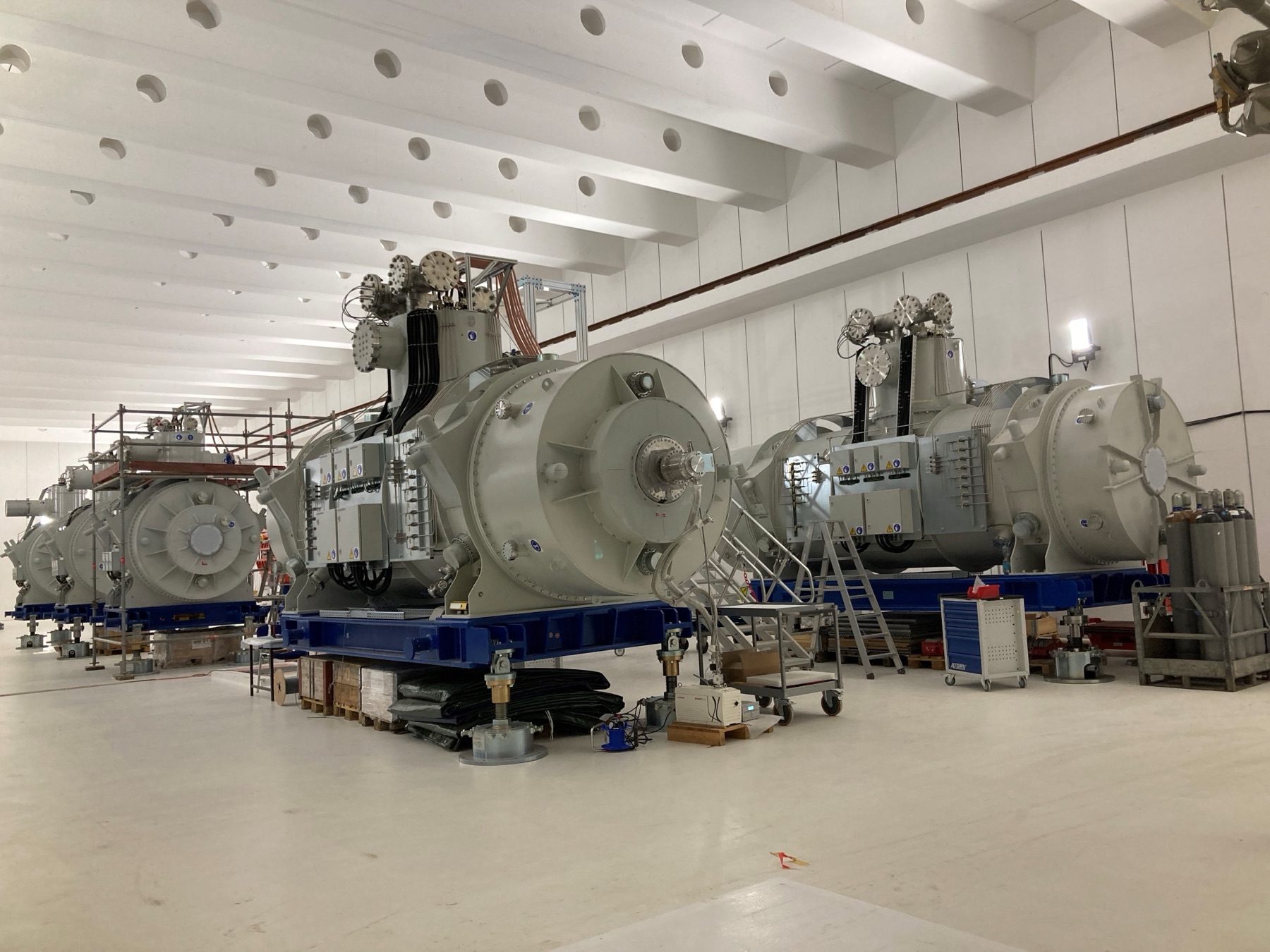
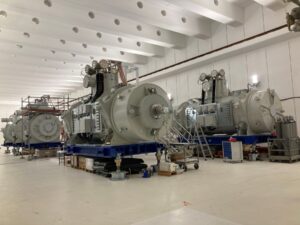
FAIR is under construction in Darmstadt, Germany. It is one of the world’s most ambitious research infrastructures for the study of ions, antiprotons and nuclear matter. Its Super Fragment Separator (Super-FRS) guides, focuses and separates particle beams using superconducting multiplets built by ASG Superconductors. Each multiplet packs several magnets of different types into a single cryostat, with the coils running in liquid helium close to absolute zero.
These assemblies weigh between thirty and seventy tonnes, the heaviest of them reaching seventy. Inside them, every voltage tap, temperature sensor, helium level probe and diagnostic line has to reach the outside world. Each one crosses two distinct boundaries through hermetic feedthroughs mounted on the cryostat turret: a pressurised helium boundary and an insulation vacuum boundary. Moreover, each boundary imposes its own combination of leak-tightness, pressure and dielectric requirements.
To meet those demands, VAC-TRON developed custom hermetic feedthrough solutions with GSI and ASG Superconductors, designed for integration into the Super-FRS magnet assemblies.
Scale and Geometry: Sizing Hermetic Feedthroughs and Their Flanges
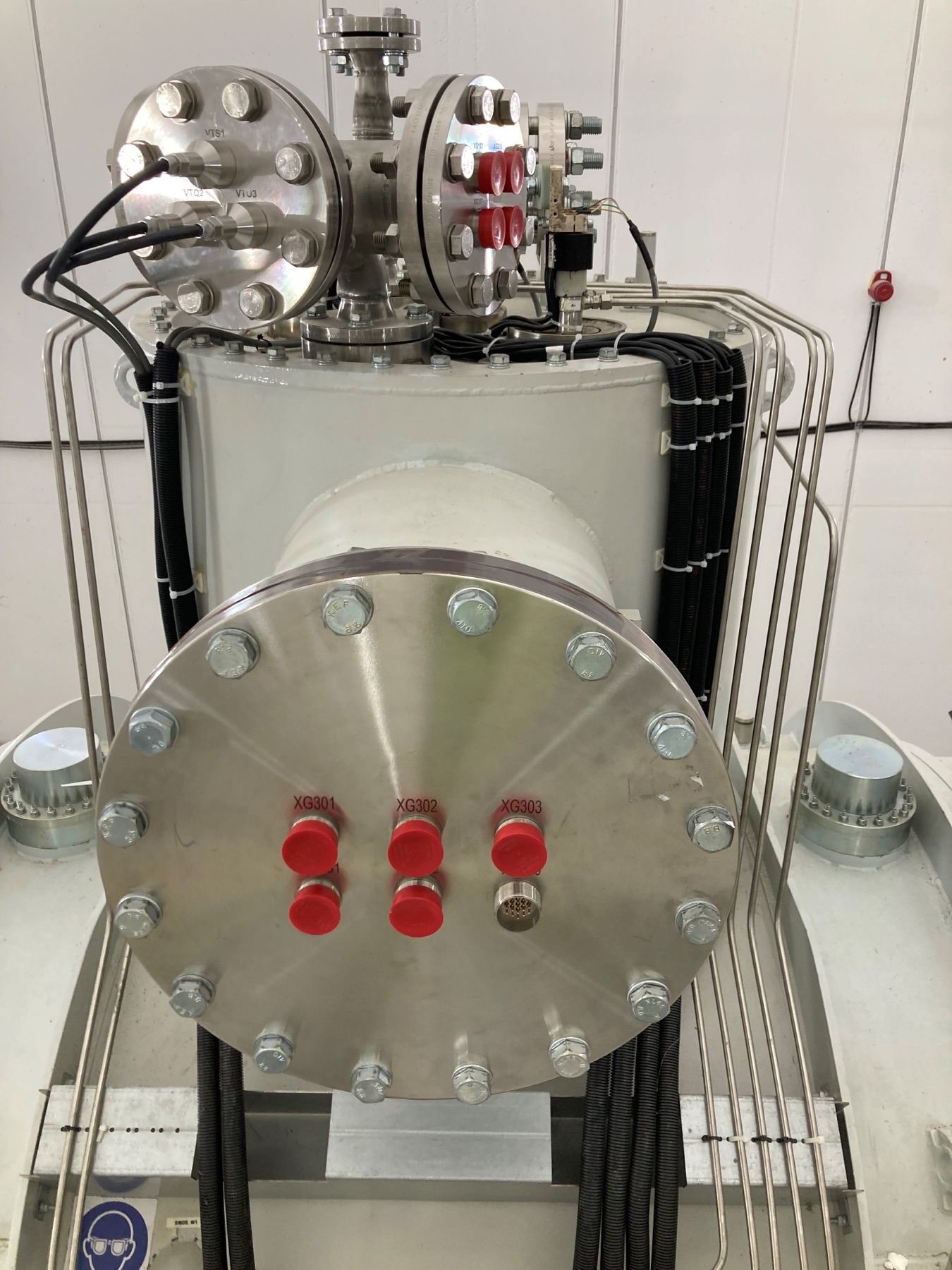
In most discussions of hermetic feedthroughs, the flange is treated as packaging. Here it is a structural, thermal and dielectric component in its own right. Consequently, its dimensions drive much of the engineering.
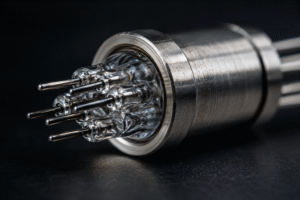
The interfaces for this programme range from DN 100 to DN 350 in stainless steel. A single flange carries anywhere from two to eleven feedthroughs. The pin configurations vary across the same flange, because the signals do. A voltage tap, a temperature sensor, a helium level probe and a diagnostic line each have different conductor counts, different insulation needs and different consequences if they fail. A complete assembly weighs from under six kilograms at the small end to over thirty at the large one.
Those numbers matter for three reasons that are easy to overlook until you are holding the part.
Handling
You cannot manipulate a thirty-kilogram stainless flange like a machined blank, especially with a dozen glass-sealed connectors on it. Each unit therefore ships with a lifting eye bolt, individual pin protectors and foam-supported packaging. After all, the most likely moment to damage a hermetic seal is not in service. It is during unpacking and installation.
Distortion
Welding a dozen connectors into a thick stainless plate pushes heat into the part. Yet its flatness and sealing face finish are part of the specification, and the vacuum side is finished to Ra 0.8. Weld sequence and heat input are therefore not shop-floor details. They are design inputs.
Layout Freedom
Eleven connectors of mixed configuration on one flange is not a standard product. The internal architecture of the multiplet dictates the positions, together with the insulation distances required between pins, between pin and shell, and between adjacent connectors. In addition, each position is individually engraved and cross-referenced to a connector identification table. A specific connector on a specific flange therefore traces back to a specific circuit inside a specific magnet. Custom geometry of this kind is where a catalogue supplier stops and an engineering supplier starts.
Hermetic Feedthroughs Under Radiation
Every connector in this programme uses Glass-to-Metal Seal (GTMS) technology, with shells in AISI 316L and pins in Alloy 52, hard gold plated over nickel. Alloy 52 earns its place not through its electrical properties, but through its thermal expansion, which matches that of the sealing glass. A glass-to-metal seal is a compression seal. Hence a mismatch of a few parts per million per degree separates a hermetic joint from a slow leak.
The customer specified a military connector pattern, in order to work with a proven and widely available interface. On the cable side, however, standard military counterparts rely on polymer or elastomer inserts to insulate and retain the contacts. Under accumulated gamma dose those materials embrittle, outgas and lose dielectric strength. VAC-TRON therefore supplied custom counterparts. The military pattern stays, so the interface and the handling practice remain standard, but PEEK replaces the insulating material.
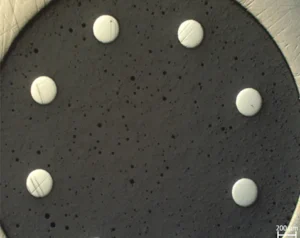
On the flange side the question changes. Glass is comparatively stable under irradiation, which is precisely why glass-to-metal sealing wins for electrical penetrations in nuclear environments. But hermeticity does not live in the glass. It lives in the glass-to-metal interface, where residual stresses concentrate and where a seal actually loses its integrity. Worse, it does not announce itself as a failure. It announces itself as a slow leak, months or years into operation, in a component nobody can reach.
That is why we selected the sealing glass on the basis of testing rather than datasheet values, and why the irradiation testing covered sealed assemblies rather than glass coupons. The ITER qualification process demonstrated the radiation hardness of the selected glass: long-term stability up to a total accumulated dose of 6 MGy, at dose rates of 4 kGy per hour and below.
Dielectric Design: Three Atmospheres on One Assembly
There is no single voltage requirement in this programme. The circuits crossing these boundaries run at very different potentials, from 100 Vdc up to 3,000 Vdc. Each interface therefore gets its own verification: dielectric strength between every pin and the shell, insulation resistance above 1 GΩ at 500 Vdc, and leakage currents below 1 to 3 µA depending on the circuit.
What turns this into a design problem rather than a specification problem is the atmospheres. Three of them meet on one assembly: air on the atmospheric side, insulation vacuum between the cryostat walls, and pressurised helium on the process side. Dielectric strength is a property of the medium at least as much as of the geometry. A clearance that is safe in air is not necessarily safe in helium. Likewise, a clearance qualified at atmospheric pressure is not necessarily qualified in vacuum. Each interface must therefore match the medium it actually faces, at the voltage that circuit actually carries.
This is the point a standard product cannot address, and the reason these hermetic feedthroughs were developed rather than selected. A connector dimensioned for air and then installed against a helium boundary will eventually fail. Worse still, it will fail on the side nobody can inspect.
Certified Welding: Joining Hermetic Feedthroughs to the Flange
The connector-to-flange joint is where the assembly succeeds or fails. It is a butt weld in austenitic stainless steel, made without filler metal, and it has to stay leak-tight for the operational lifetime of the installation.
VAC-TRON laser welds these joints under a qualified procedure. The procedure follows EN ISO 15609-4 and holds qualification to ISO 15614-11:2017, with welder qualification to UNE-EN ISO 9606-1 and visual examination to UNE-EN ISO 17637. Acceptance follows quality level B of ISO 13919-1, the most stringent level defined for laser and electron beam welds. In addition, an independent accredited laboratory carries out macrographic and micrographic examination to ISO 17639.
Certification here is not paperwork attached to the process. Rather, it is the only reason a joint made once can be made identically across an entire production series.
Qualifying Hermetic Feedthroughs: Validate First, Manufacture Second
These are custom parts. On a bespoke design, the problems that matter are the ones nobody anticipated. Besides, the worst moment to discover them is halfway through a production series.
Validation Before Production
The programme therefore begins with a mock-up rather than with production. VAC-TRON manufactures and inspects a fully functional unit, with representative flange, representative connectors and representative welds, and delivers it to the customer. The customer then tests it under the actual working conditions of the installation. Series manufacturing waits until that unit passes. This adds time at the front of the schedule. In exchange, it removes the risk of rework across an entire batch, which on custom hermetic feedthroughs is not a favourable trade to get wrong.
Testing at Three Stages
Once the series is released, verification is not statistical. A single leak can force a magnet assembly to be warmed up, disassembled and recommissioned. Sampling is therefore not an acceptable quality strategy. Instead, testing happens at three stages. Every feedthrough passes an individual test before welding: helium leak tightness, insulation resistance and dielectric strength. Every feedthrough passes the same test again once welded into the flange, because the weld itself can affect the seal beside it. Finally, the completed flange qualifies as an assembly, with pressure testing over repeated cycles and a final helium leak test of the whole unit.
A component that passed at the first stage and fails at the second has told you something useful. A component tested only at the end has not.
The Documentation Package
The delivered documentation reflects the same principle: factory acceptance test records, as-built drawings and 3D models, certificate of conformity, EC declaration of conformity, welding procedure and qualification records, and material certificates to EN 10204 3.1. For a Big Science customer, documentation is not administrative overhead attached to the part. In practice it is half of the part.
What Actually Transfers Between Scientific Programmes
It is tempting to describe technology transfer as reusing a product in a new context. That is rarely what happens, and it is not what happened here. No ITER component was fitted to a Super-FRS multiplet.
What transferred was the sealing technology and the way we qualify it. First, the glass itself, together with an understanding of how a glass-to-metal seal behaves under accumulated dose. That means knowing that radiation tolerance has to be demonstrated on the sealed assembly rather than inferred from a datasheet, and having the testing to back it up. Second, the procedural apparatus that a fusion programme forces you to build: qualification plans, traceability, documentation packages, and the discipline of testing every unit rather than a sample. In these environments, after all, a field failure costs months of lost operation.
The commercial consequence is shorter development cycles and lower qualification risk for the customer. The engineering consequence is simpler still. A supplier who has already solved the hard version of a problem starts from a different place than one who has not.
Beyond FAIR: Where Else Hermetic Feedthroughs Face the Same Limits
The same combination of constraints appears well outside particle physics. Aerospace systems in radiation environments, nuclear instrumentation, cryogenic equipment, implantable and diagnostic medical devices and high-integrity industrial monitoring share one need. All of them require hermetic electrical interfaces that survive conditions where maintenance is impractical or impossible.
The transferable asset is not a part number. It is a qualified process chain: sealing glass selection with demonstrated radiation behaviour, expansion-matched pin materials, dielectric design against the correct medium, certified welding to ISO 13919-1 level B, and 100 percent verification with a documentation trail that survives an audit. VAC-TRON applies the same chain to multipin feedthroughs and single feedthroughs across every sector it serves.
Conclusion: What Hermetic Feedthroughs Have to Be
The Super-FRS programme shows what hermetic feedthroughs actually have to be in a zero-failure environment. Not a connector, but an assembly. A stainless steel flange carries a variable population of glass-to-metal sealed feedthroughs in a custom layout. Each circuit matches the medium it faces. Laser welds under a certified procedure hold it together. A sealing glass qualified by irradiation testing on sealed assemblies sits at its core. And a mock-up validates the whole design before any series part is manufactured.
Every unit is then tested. Not a sample of the batch, but every feedthrough and every completed flange, verified leak-tight to better than 1×10⁻⁸ mbar·l·s⁻¹ before it ships.
None of those requirements is remarkable in isolation. Meeting all of them in the same component, repeatably, across a production series, and being able to prove it afterwards, is the whole of the engineering.
Do you have a hermetic interface that cannot fail? Tell us about your application and we will tell you what it takes to qualify it.
VAC-TRON has manufactured hermetic glass-to-metal sealed feedthroughs in Barcelona since 1985, producing over two million pieces per year for customers around the world, under ISO 9001, EN 9100 and ISO 14001 certification. We develop and qualify custom hermetic feedthroughs for vacuum, pressure and radiation environments in-house.