A hermetic glass-to-metal seal (GTMS) is the gold standard for protecting electronic components in extreme environments. From aerospace to high-precision medical instrumentation, industries where failure is not an option depend on glass to metal seal technology to shield critical assemblies against moisture, pressure, and temperature extremes.
At Vac-Tron, after years of engineering custom hermetic solutions, we know that GTMS delivers what no polymer, epoxy, or mechanical seal can: a permanent, inorganic hermetic bond with near-zero leak rates.
What Is a Glass to Metal Seal (GTMS)?
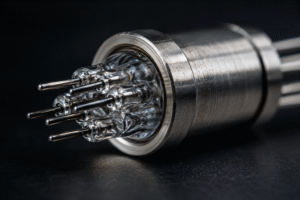
A glass to metal seal (GTMS) is an advanced engineering process in which a specially formulated glass is fused directly to a metallic housing and one or more conductors, creating a permanent hermetic bond at the molecular level. Unlike organic seals — such as epoxies or polymer gaskets — GTMS does not degrade over time, does not allow gas permeation, and maintains its properties through severe thermal cycling and radiation exposure.
The key to a reliable GTMS joint is thermal expansion matching: the glass and metal alloys (typically Kovar, Alloy 42, or stainless steel) must expand and contract at compatible rates. When correctly engineered, hermetic assemblies achieve helium leak rates below 1 × 10⁻⁹ mbar·L/s — the benchmark for true hermetic performance.
Why Engineers Choose Glass to Metal Seal Technology
Engineers specify GTMS when no other sealing method meets performance requirements. Here are three core reasons glass to metal seal is the technically superior choice for sensors, connectors, feedthroughs, and hermetic packages:
Permanent Hermeticity
GTMS provides an absolute barrier against moisture, gas, and contaminants. Verified by mass spectrometer leak testing, helium leak rates routinely fall below 1 × 10⁻⁹ mbar·L/s — far exceeding the requirements of MIL-STD-883 and equivalent defence standards.
Resistance to Extreme Conditions
GTMS assemblies operate successfully across temperature ranges from −200°C to over +450°C, withstanding pressures up to 50,000 psi. This makes them the preferred choice for downhole oil & gas tools, cryogenic sensors, and nuclear instrumentation.
Superior Electrical Insulation
The glass matrix in a GTMS acts as a precision dielectric insulator, maintaining electrical isolation between conductors and housing — even at miniaturised dimensions, high voltages, and across the full operating temperature range. Critical for multi-pin hermetic connectors and RF feedthroughs.
Applications: Where Precision Meets Durability
Vac-Tron GTMS solutions are used across demanding industries where long-term reliability is non-negotiable:
- Aerospace & Defence — hermetic feedthroughs for satellites, avionics, and missile systems
- Oil & Gas — downhole sensors and connectors rated for extreme pressure and temperature
- Medical Devices — implantable pacemakers, neurostimulators, and diagnostic equipment
- Nuclear & Industrial — sealed instrumentation for radiation-hardened environments
- Scientific Instruments — vacuum chambers, mass spectrometers, and electron microscopy components
The Value of Custom Engineering
At Vac-Tron, every glass to metal seal assembly is engineered from the ground up. Each application presents unique challenges: thermal expansion coefficients, conductor geometry, pin count, pressure differential, and operating frequency. Our team works directly with customers to select the right glass composition, metal alloys, and manufacturing process — whether compression seal, matched seal, or solderable assembly — ensuring the product exceeds specification across its entire service life.
Ready to Seal Your Next Critical Design?
Are you working on a project that demands absolute hermeticity?
At Vac-Tron, we transform complex technical challenges into robust engineering
solutions. Contact our engineering team today and let’s discuss how to optimize
your next design.