When hermetic performance is non-negotiable, the choice between a glass to metal seal vs ceramic seal can make or break your design. Glass-to-metal seals (GTMS) and ceramic-to-metal seals are the two dominant technologies in demanding industries — but they are not interchangeable. Understanding their differences is essential before specifying a feedthrough, connector, or sensor package for aerospace, oil & gas, medical, or nuclear applications.
This guide breaks down both technologies from first principles, compares their performance across the parameters that matter most to engineers, and gives you a clear framework for choosing the right seal for your application.
What Is a Glass-to-Metal Seal?
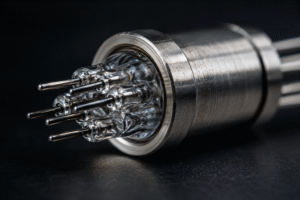
A glass to metal seal (GTMS) — also written as glass-to-metal seal — is a permanent hermetic bond created by fusing a specially formulated glass directly to a metallic housing and one or more electrical conductors. The glass acts simultaneously as a mechanical anchor, an electrical insulator, and a hermetic barrier — all in a single material interface.
The key to a reliable GTMS joint is thermal expansion matching between the glass and the metal alloys used. At Vac-Tron, we work primarily with controlled-expansion alloys such as Kovar and Alloy 42, paired with borosilicate or aluminosilicate glasses engineered to match their expansion coefficients. When properly designed, the fused joint achieves hermeticity levels below 1 × 10⁻¹⁰ Pa·m³/s — well within the most demanding specifications in aerospace and nuclear environments.
GTMS technology has been in commercial use since the mid-20th century and remains the standard for applications where absolute long-term hermeticity, dielectric performance, and resistance to thermal cycling are required.
What Is a Ceramic-to-Metal Seal?
A ceramic-to-metal seal achieves hermeticity by joining a ceramic body — typically alumina (Al₂O₃) or beryllia (BeO) — to a metallic frame, usually through a brazing process. The ceramic is first metallized (coated with a metal layer), then brazed to the housing using active metal brazing or the molybdenum-manganese (Mo-Mn) process.
Ceramic seals are widely used in microwave and RF components, power electronics, and high-voltage applications where the superior mechanical strength and specific electrical properties of ceramics are needed.
Head-to-Head: GTMS vs Ceramic Seal
1. Hermeticity
GTMS creates a monolithic bond at the molecular level — the glass flows and fuses directly to the metal during the firing process, leaving no interface susceptible to delamination or diffusion over time. Helium leak rates below 2.69 × 10⁻¹⁰ Pa·m³/s are routinely achieved and verified per MIL-STD-883 and verified by mass spectrometer leak testing.
Ceramic seals rely on a brazing interface between the metallized ceramic surface and the metal housing. This interface introduces an additional material boundary that can be a source of failure under aggressive thermal cycling or mechanical shock.
Verdict: Both achieve comparable peak hermeticity. GTMS has a slight edge in long-term stability under aggressive thermal cycling.
2. Temperature Range
GTMS performs reliably across a temperature range of –195°C to +300°C, making it suitable for cryogenic applications and high-temperature downhole tools. Ceramic seals outperform glass at the upper end, operating above 500°C and in some cases up to 800–900°C.
Verdict: GTMS covers the vast majority of industrial and aerospace temperature ranges. Ceramic seals are the right choice above ~350°C.
3. Mechanical & Pressure Resistance
GTMS components at Vac-Tron are specified and tested for pressure ratings up to 2,500 bar (36,250 psi), making them the industry standard for downhole oil & gas tools and subsea instrumentation. The compressive nature of matched glass-to-metal seals improves performance under pressure — the glass is placed in compression by the surrounding metal.
Verdict: GTMS is the preferred choice for high-pressure applications.
4. Electrical & Dielectric Performance
GTMS provides dielectric strength between 500V and 6,000V DC. The low dielectric constant of glass (4–6) makes GTMS feedthroughs ideal for DC and low-frequency applications. Ceramic seals are the standard choice for RF and microwave applications, with alumina offering a dielectric constant of 9–10.
Verdict: Glass for DC and low-frequency; ceramic for RF/microwave.
5. Miniaturization & Pin Density
GTMS excels in high pin-count, small-pitch designs. Glass can be formed around conductors as small as 0.1 mm in diameter. Ceramic seals become more complex and costly at very high pin counts.
Verdict: GTMS is the better choice for high pin-density, miniaturized configurations.
6. Cost & Lead Time
GTMS components are less expensive and faster to produce than ceramic-to-metal assemblies at equivalent complexity. The glass-seal firing process is scalable and well-understood; ceramic metallization and brazing require additional process steps.
Verdict: GTMS offers better cost-performance ratio for most industrial and defense applications.
Quick Reference: GTMS vs Ceramic at a Glance
| Parameter | Glass-to-Metal Seal | Ceramic-to-Metal Seal |
|---|---|---|
| Hermeticity | < 2.69 × 10⁻¹⁰ Pa·m³/s | Comparable |
| Temperature range | –195°C to +300°C | Up to 800°C+ |
| Max pressure | Up to 2,500 bar | Lower (brittle under shock) |
| Dielectric strength | 500V–6,000V DC | High |
| RF/Microwave | Limited | Excellent |
| Miniaturization | Excellent | Moderate |
| Pin density | Very high | Moderate |
| Unit cost | Lower | Higher |
| Lead time | Shorter | Longer |
When to Choose a Glass to Metal Seal vs Ceramic Seal Alternative
- High-pressure environments — downhole tools, subsea systems, hydraulic instrumentation
- Extreme thermal cycling — space components, cryogenic systems, automotive sensors
- High pin-count feedthroughs — multi-channel signal conditioning, data acquisition in harsh environments
- Miniaturized hermetic packages — implantable devices, microelectronic housings
- Long-term hermeticity without maintenance — permanently sealed assemblies with 20+ year service life
When to Choose Ceramic Seal
- RF or microwave signal transmission — radar, satellite communications, microwave power modules
- Sustained temperatures above 350°C — industrial furnaces, high-temperature power electronics
- High-power laser or LED packages — where BeO or AlN ceramics provide thermal conductivity alongside hermeticity
The Bottom Line: Choosing Between Glass to Metal Seal vs Ceramic Seal
For the majority of industrial, aerospace, oil & gas, nuclear, and medical applications, GTMS delivers superior hermeticity, pressure resistance, miniaturization capability, and cost efficiency. Ceramic seals have a clear place when RF performance, extreme high temperature, or specific dielectric properties are the primary design driver.
Specify Your Hermetic Seal with Vac-Tron
With over 40 years designing and manufacturing glass-to-metal sealed components, Vac-Tron has the engineering expertise to help you select the right hermetic solution — from feasibility study through certified production. Our components meet EN 9100, ISO 9001, MIL-STD, and JEDEC standards, manufactured in our ISO 8 cleanroom in Canovelles, Barcelona.
Contact our engineering team → to discuss your requirements, or browse our product range → to find a starting point for your design.